
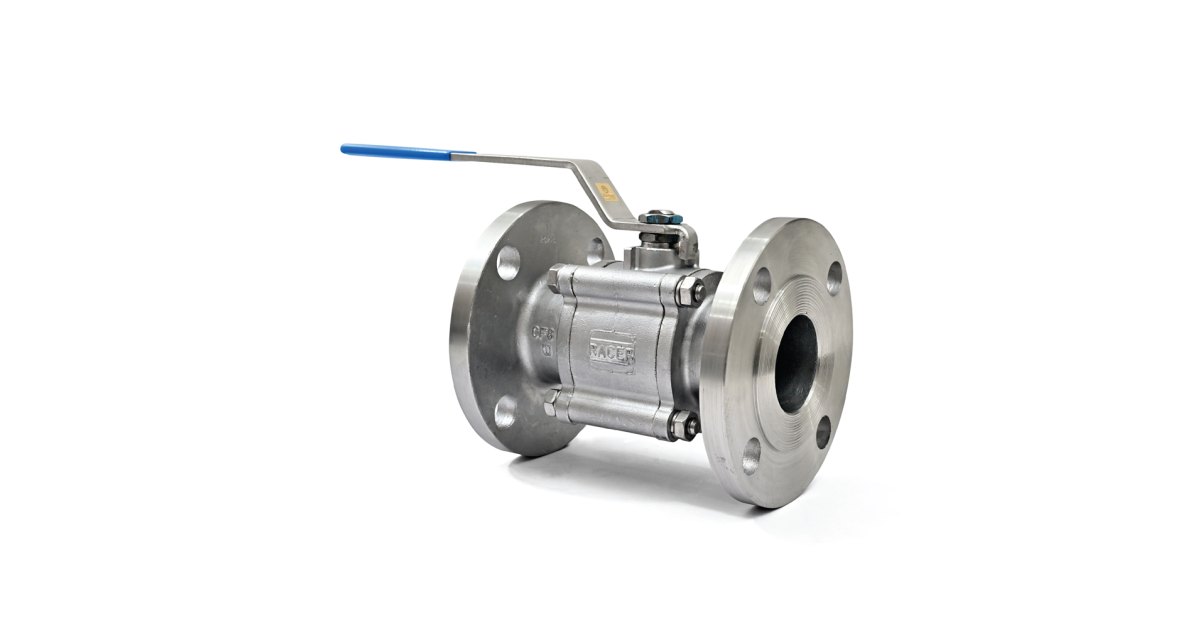
A ball valve looks simple: a drilled sphere that turns ninety degrees. That simplicity is exactly why it is so often specified badly. The valve is chosen on line size and price alone, and the seat material or the bore type turns out to be wrong for the duty.
Below is the order we work through when a customer asks us to recommend a valve.
1. Start with the medium, not the line size
What flows through the valve dictates almost everything else. Clean water, steam, slurry, hydrocarbon and aggressive chemicals each push you toward a different body and seat combination.
- Water and general utility: cast iron or investment cast stainless, PTFE seats.
- Steam: stainless body with reinforced PTFE or graphite seats, rated for the saturation temperature, not just the pressure.
- Corrosive chemicals: polypropylene or PVDF for lower pressures, stainless 316 where strength is also needed.
- Slurries and solids: full bore only, with a seat material that tolerates abrasion.
2. Full bore or reduced bore
In a full bore valve the ball opening matches the pipe inside diameter, so flow passes with almost no additional resistance. A reduced bore valve steps the opening down by roughly one pipe size.
Choose full bore when the line is pigged, when solids are present, or when pressure drop matters across a long run. Choose reduced bore when the duty is clean, throttling is occasional and cost or weight matters. A reduced bore valve is smaller, lighter and cheaper, and in a clean water line the extra drop is often irrelevant.
3. Match the pressure class to the real operating temperature
Pressure ratings fall as temperature rises. A valve stamped 300# does not hold 300# of pressure at 200°C. Always read the pressure-temperature curve for the body material rather than the number on the tag, and size against the highest temperature the line will actually see, including steam-out and cleaning cycles.
4. Decide the end connection early
This is a detail that causes more site delays than any other, because it has to agree with the flanges already in the line.
| Connection | Typical use | Watch for |
|---|---|---|
| Screwed / threaded | Small bore utility, up to about 2 inch | Thread standard must match (BSP vs NPT) |
| Flanged | Most process lines | Flange standard and rating must match the mating flange |
| Wafer | Where space and weight are tight | Needs correct bolting and support |
| Socket weld / butt weld | High pressure, no-leak duty | Valve must be weldable and seats protected during welding |
5. Think about how it will be operated
A lever is fine for a valve that is turned occasionally at waist height. A valve that is operated daily, sits above head height, or needs a controlled closing speed should be geared. If it is part of a control loop it needs an actuator, and the actuator torque must be sized on the valve breakaway torque, not the running torque.
A short checklist
- Medium, including anything used to clean the line
- Operating and peak temperature
- Operating and test pressure
- Full bore or reduced bore
- Body and seat material
- End connection and standard
- Operation: lever, gear or actuator
- Frequency of operation and accessibility
If you can answer those eight points, specifying the valve becomes straightforward. If any one of them is uncertain, that is usually where the failure will come from later.
Send us the duty conditions and we will come back with a recommendation and a drawing.
